
Wonder Town › Guides › Math at home
Long division games: the steps explained for parents

Long division is where many children first meet a problem that takes several steps, and each step leans on something learned earlier: the times tables, subtraction, place value. In the United States it arrives in 4th grade (three-digit numbers divided by one digit) and grows in 5th grade (dividing by two-digit numbers). This guide explains the steps the way your child’s class probably teaches them, gives you four quick games for home, and shows where to practise it in Wonder Town.
What your child needs first
Long division goes smoothly when three things are already easy:
- Multiplication facts up to 9 × 9. Every step asks “how many 7s fit?”. If the facts are shaky, start there: see Multiplication games: learning the times tables at home.
- Subtraction with regrouping. Each step subtracts what has been used.
- Place value. Knowing that the 5 in 585 means 500 is what makes the steps make sense.
Two ways schools teach it
Most American classrooms start with partial quotients, then move to the standard algorithm. Both give the same answer; partial quotients shows why it works. Here is 585 ÷ 9 both ways.
Partial quotients: take away easy chunks.
- How many 9s can I take away easily? Ten 9s are 90, so sixty 9s are 540. 585 − 540 = 45 left.
- How many 9s are in 45? Five. 45 − 45 = 0.
- Add the chunks: 60 + 5 = 65.
The standard algorithm: one digit at a time.
- 9 does not go into 5, so look at 58. 9 × 6 = 54. Write 6 above the 8; 58 − 54 = 4.
- Bring down the 5 to make 45. 9 × 5 = 45. Write 5; 45 − 45 = 0.
- The answer is 65.
Check it by multiplying: 65 × 9 = 585. Teaching your child to check every answer this way is the single most useful long-division habit.
When it does not come out even
143 ÷ 8: ten 8s are 80 and seven more 8s are 56, so seventeen 8s are 136. 143 − 136 = 7 left over. The answer is 17 remainder 7, and the remainder must always be smaller than the divisor (7 is smaller than 8). Check: 17 × 8 + 7 = 143.
Four long division games for home
These take five minutes, need nothing you do not already have, and work for 4th and 5th graders.
- Share the snacks. Count out 52 raisins (or coins, or crackers) and share them between 4 plates. Write down what you did: 52 ÷ 4 = 13. Then try 53. Where does the extra one go? That is a remainder.
- Dice division. Roll three dice to make a three-digit number, and one die for the divisor (re-roll a 1). Both of you solve it; whoever checks it first by multiplying wins the round.
- Guess first. Before solving, everyone guesses: is 585 ÷ 9 more or less than 50? Than 100? Estimating first catches answers that are ten times too big, the most common long-division slip.
- Spot the mistake. Write a long division with one wrong step and let your child find it. Being the teacher is often easier than being the student, and it shows which step they really understand.
How to practise long division in Wonder Town
Wonder Town is a math adventure game: your child walks through floating 3D towns and answers villagers’ questions to reach the gate before disaster strikes. Each town practises one topic of the loaded question bank.
In the US 4th grade question bank, towns 3 and 4 practise long division and towns 5 and 6 add remainders. The first three towns are free with a free account, so town 3, the first long-division town, costs nothing.

After a wrong answer, the villager explains the problem the partial-quotients way, then asks a new one of the same kind:

Other question banks with long division:
- US 5th grade: dividing by two-digit numbers, such as 672 ÷ 21, started with an estimate (town 12).
- Japan 4th grade: long division in towns 3 and 4.
- China 3rd grade (dividing by one digit, towns 5 and 6) and 4th grade (two-digit divisors, towns 5 and 6).
Every question bank, from every country, is in English, Chinese and Japanese. If your child brings home a marked division worksheet, you can also turn it into a question bank, and the missed questions come back until they stick.
Start here: Math games for 4th graders · Math games for 5th graders · All 4th grade math questions, with answers
More guides
 Math at homeMultiplication games: learning the times tables at homeWhat multiplication means, a smart order for learning the facts to 9 × 9, five times-table games to play at home, and a free math adventure for 3rd graders.November 21, 2026 · 4 min read
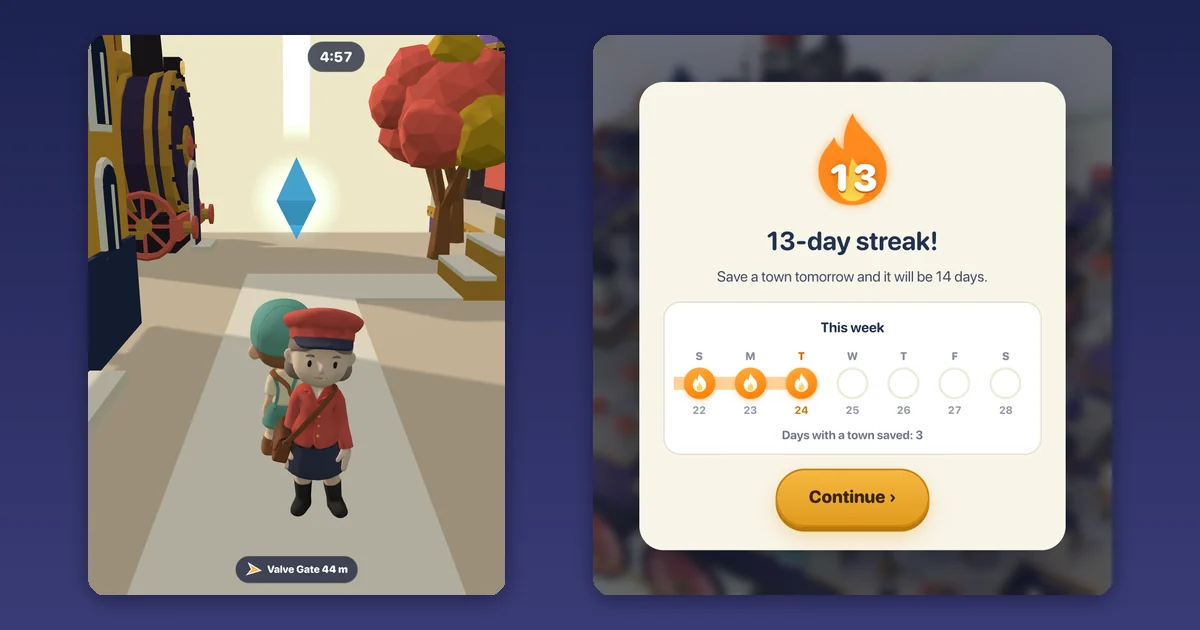 How-to guidesDaily streak and freeze gems: save a town every daySave any town in Wonder Town on a day and that day counts for your daily streak. Where to see the streak and the week, how freeze gems keep it through a missed day, and where the gems hide.November 24, 2026 · 6 min read
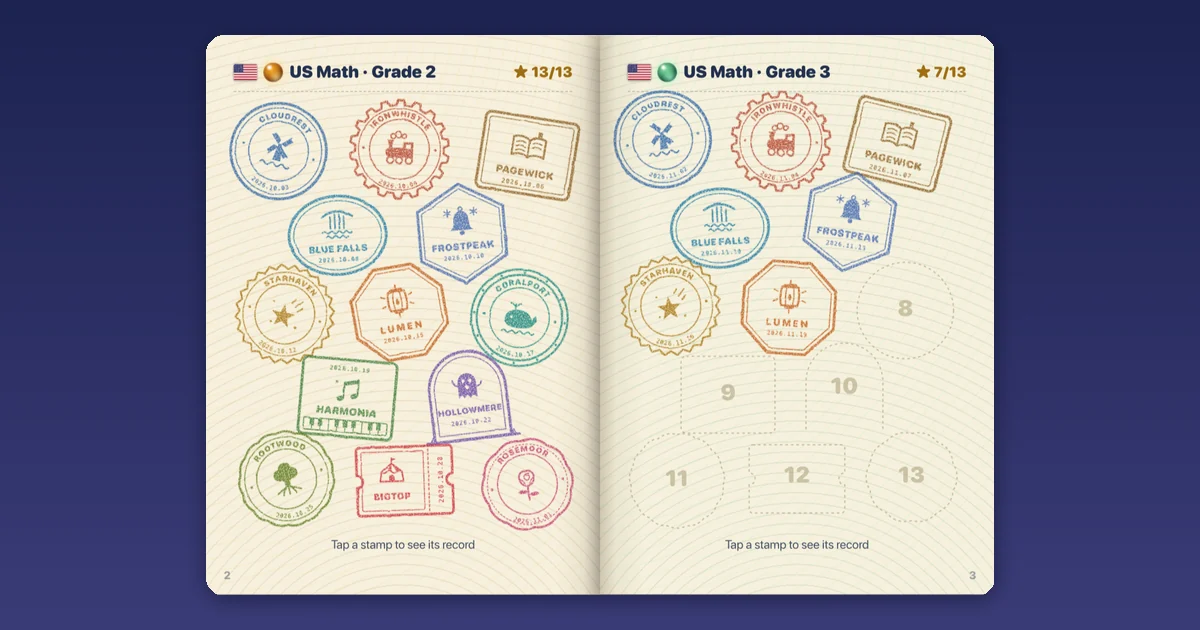 How-to guidesPassport stamps: one for every town you saveEvery town saved in Wonder Town puts a stamp in your Passport, a little book with a page per question bank. How to open it, turn its pages and read each stamp.November 22, 2026 · 6 min read