
Wonder Town › Singapore Math games
Singapore Math games for Primary 1 to 5
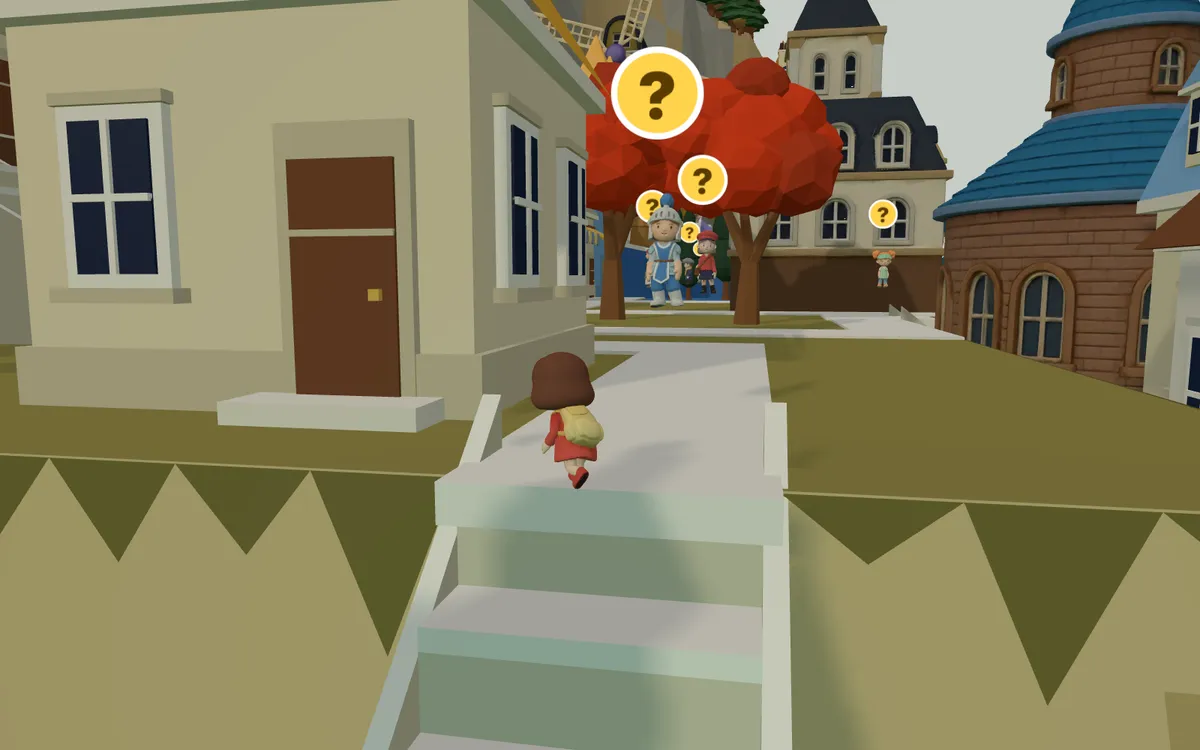
Wonder Town has five question banks that follow Singapore’s MOE primary mathematics syllabus (2021), one for each level from Primary 1 to Primary 5. Your child practises them in a 3D adventure: villagers in floating towns ask the questions, and the answers open the road to the gate.
First town: no account needed · First 3 towns free · No download
Plays onComputersiPad and tabletsiPhone and Android
The short answer
Load a Singapore bank and the first twelve towns walk through its topics in syllabus order, from number bonds and making 10 in Primary 1 to percentage, rate and the volume of a cuboid in Primary 5; the thirteenth town reviews them all. Word problems are written the way the bar model reads them, in units, and each explanation follows the method Singapore classrooms use.
The first three towns are free with any bank, and the first one needs no account. Every Singapore bank is also written in Chinese and Japanese, which helps children who learn maths in English at school and speak Mandarin at home.
Wonder Town at a glance
- What it is
- A 3D math adventure game for kids in grades 1–5 (ages 6–11)
- Free
- The first 3 towns
- Account
- None needed for the first town; a free account for towns 2 and 3
- Passport
- $19.80 a month: all 13 towns, cancel any time
- Own question banks
- With the Passport, from photos of tests and homework
- Towns
- 13, each with its own story; the last one reviews every topic
- Ads and chat
- None
- Plays on
- Computers, iPad and other tablets, iPhone and Android phones, in the browser; no download
Where it is in the game
Some of the Singapore topics and the towns that practise them. Each bank page lists all eight topics of its level with sample questions.
| Question bank | Topic | Towns |
|---|---|---|
| Singapore · Primary 1 | Number bonds | Town 1 · no account Town 2 · free account |
| Singapore · Primary 1 | Bar model word problems | Town 12 · Passport |
| Singapore · Primary 2 | Multiplication tables of 2, 3, 4, 5 and 10 | Town 5 · Passport Town 6 · Passport |
| Singapore · Primary 3 | Multiplication tables of 6, 7, 8 and 9 | Town 3 · free account Town 4 · Passport |
| Singapore · Primary 3 | Bar model word problems | Town 7 · Passport Town 8 · Passport |
| Singapore · Primary 4 | Fractions | Town 5 · Passport Town 6 · Passport |
| Singapore · Primary 5 | Fractions | Town 3 · free account Town 4 · Passport |
| Singapore · Primary 5 | Percentage | Town 6 · Passport Town 7 · Passport |
All question banks, with their topics and sample questions →
Sample questions from the game
From the game’s Singapore generators. The bar model is in the words of the problem and of the explanation; the game does not draw the bars.
Complete the number bond: 8 and ? make 10.
- 2
- 18
- 3
- 1
How to think about it: 10 is the whole and 8 is one part. The other part is 2, because 8 + 2 = 10.
Ahmad has 39 curry puffs. Siti has 10 more curry puffs than Ahmad. How many curry puffs does Siti have?
- 48
- 59
- 49
- 29
How to think about it: Draw two bars: Siti's bar is 10 longer than Ahmad's. 39 + 10 = 49.
Ravi has 2 times as many stamps as Wei Ling. They have 204 stamps altogether. How many stamps does Wei Ling have?
- 202
- 68
- 136
- 102
How to think about it: Bar model: Wei Ling is 1 unit and Ravi is 2 units, 3 units in all. 3 units = 204, so 1 unit = 204 ÷ 3 = 68.
What is the first common multiple of 7 and 6?
- 49
- 42
- 13
- 84
How to think about it: List the multiples of 7: 7, 14, 21, 28, 35, 42. The first one that is also a multiple of 6 is 42.
A family dinner costs $200 before GST. GST is 9%. How much is the GST?
- $180.00
- $9.00
- $218.00
- $18.00
How to think about it: GST = 9% of $200 = 9/100 × 200 = $18.00.
How it fits with Singapore Math at school
- Singapore Math moves from concrete to pictorial to abstract. The game is the abstract step: counters, drawings and bar models belong on the table, and the villagers’ questions are the practice afterwards.
- For a bar model word problem, have your child sketch the bars on scrap paper before choosing an answer, then read the explanation if it was wrong.
- The banks follow the MOE syllabus level by level, not one textbook series. If your child uses a Singapore Math book at home, open the bank page for the level and check its topics against the book.
Who it suits
A good fit if
- Your child is in Primary 1 to 5 in Singapore, or follows Singapore Math elsewhere
- You want daily practice of number bonds, mental strategies and bar model problems
- Your family uses English and Mandarin or Japanese
Look elsewhere if
- You need Primary 6 or PSLE preparation: the banks stop at Primary 5
- You want drawn bar models and diagrams: questions are text only
Questions parents ask
Does it follow the Singapore MOE syllabus?
Yes. The five Singapore banks follow the MOE Primary Mathematics Syllabus (2021), one bank per level from Primary 1 to Primary 5, with the topics in syllabus order.
Is it only for children in Singapore?
No. Families anywhere who use Singapore Math can choose these banks, and any bank can be played in English, Chinese or Japanese.
Does it cover the bar model?
Yes, in word problems: Primary 1 compares two bars, Primary 3 works with units (“the bag costs 3 times as much as the wallet”). The bars are described in words, not drawn.
Is it free?
The first three towns are free with any bank: the first without an account, towns 2 and 3 with a free account. The Passport ($19.80 a month) opens all thirteen towns.
Further reading
- Bilingual math games in English, Chinese and Japanese
- Chinese math games for grades 1 to 5
- Fraction games for kids, in a 3D adventure
- The learning ideas behind Wonder Town
- Turn your child’s worksheets into a math game
More answers for parents
Math RPG games · A Prodigy alternative · Math games with no ads · For kids who hate math · Multiplication games · Fraction games · Chinese math games · Bilingual math games · Turn a worksheet into a game