
Wonder Town › Fraction games
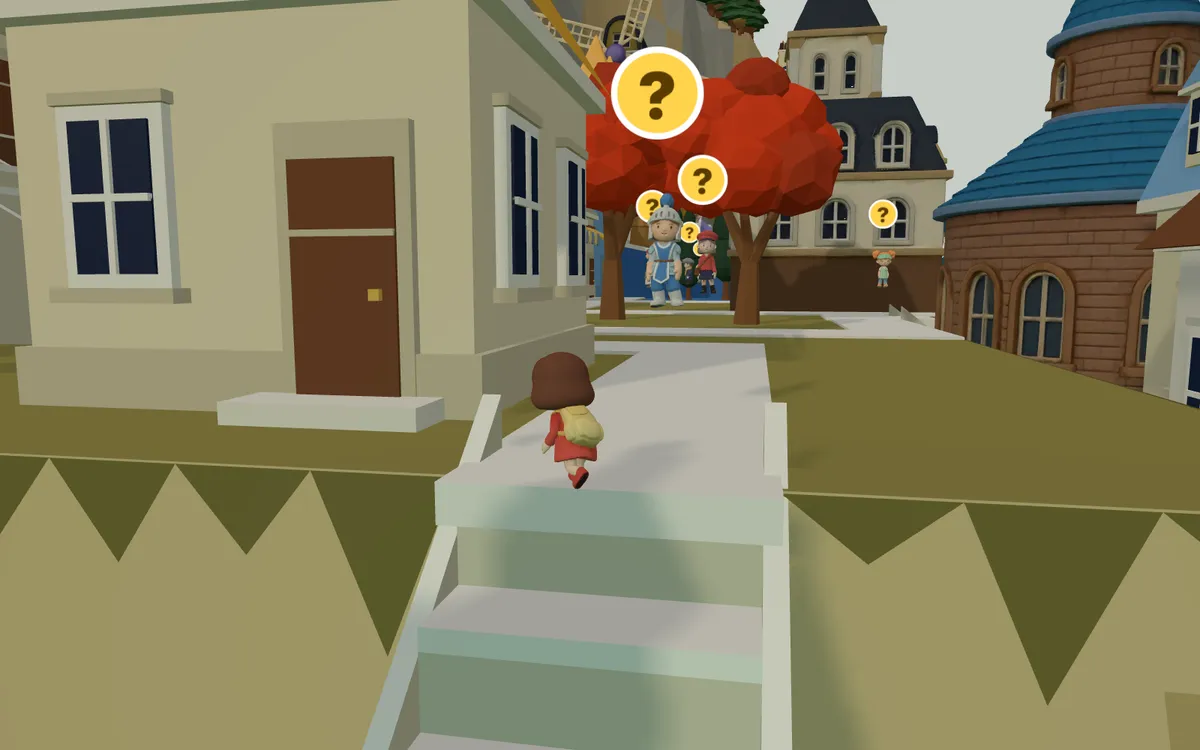
Fraction games for kids, in a 3D adventure
Fractions are where many children first feel lost: a bigger number on the bottom makes a smaller piece, and 2/4 is somehow the same as 1/2. Wonder Town practises fractions one idea at a time, in towns your child crosses by answering the villagers’ questions.
First town: no account needed · First 3 towns free · No download
Plays onComputersiPad and tabletsiPhone and Android
The short answer
In the US question banks, fractions start in 3rd grade with comparing fractions (towns 7 and 8), go on in 4th grade to equivalent fractions (towns 7 and 8) and adding fractions with the same denominator (towns 9 and 10), and reach unlike denominators (towns 5 and 6) and a fraction of a number (town 11) in 5th grade. Those towns come after the three free ones, so they need the Passport ($19.80 a month).
To try fractions for free, load the Singapore Primary 5 or the India Class 5 bank: town 3, free with an account, practises fractions. With a Passport, photos of your child’s own fraction worksheets can also become a question bank of their own.
Wonder Town at a glance
- What it is
- A 3D math adventure game for kids in grades 1–5 (ages 6–11)
- Free
- The first 3 towns
- Account
- None needed for the first town; a free account for towns 2 and 3
- Passport
- $19.80 a month: all 13 towns, cancel any time
- Own question banks
- With the Passport, from photos of tests and homework
- Towns
- 13, each with its own story; the last one reviews every topic
- Ads and chat
- None
- Plays on
- Computers, iPad and other tablets, iPhone and Android phones, in the browser; no download
Where it is in the game
The towns that practise fractions on their own, in each bank. The thirteenth town of every bank reviews all its topics, fractions included.
| Question bank | Topic | Towns |
|---|---|---|
| US · Grade 3 | Comparing fractions | Town 7 · Passport Town 8 · Passport |
| US · Grade 4 | Equivalent fractions | Town 7 · Passport Town 8 · Passport |
| US · Grade 4 | Adding fractions | Town 9 · Passport Town 10 · Passport |
| US · Grade 5 | Fractions with unlike denominators | Town 5 · Passport Town 6 · Passport |
| US · Grade 5 | Fraction of a number | Town 11 · Passport |
| Singapore · Primary 5 | Fractions | Town 3 · free account Town 4 · Passport |
| India · Class 5 | Fractions | Town 3 · free account Town 4 · Passport |
| Singapore · Primary 4 | Fractions | Town 5 · Passport Town 6 · Passport |
| China · Grade 5 | Simplifying and adding fractions | Town 10 · Passport Town 11 · Passport |
| Japan · Grade 4 | Improper fractions and mixed numbers | Town 12 · Passport |
All question banks, with their topics and sample questions →
Sample questions from the game
Made by the same generators the game uses; every question is text with four choices.
2/3 = ?/9
- 5
- 3
- 6
- 7
How to think about it: The bottom was multiplied by 3, so multiply the top by 3 too: 2 × 3 = 6.
Which is larger: 1/3 or 2/3?
- 2/3
- 2/6
- 1/6
- 1/3
How to think about it: The pieces are the same size (3ths), so more pieces is more: 2 > 1.
4/12 + 6/12 = ?
- 10/12
- 2/12
- 11/12
- 10/24
How to think about it: Same denominator: add the tops and keep the bottom. 4 + 6 = 10, so 10/12.
1/2 + 1/3 = ?
- 2/6
- 5/6
- 1
- 2/5
How to think about it: Use the common denominator 6: 3/6 + 2/6 = 5/6.
What is 2/3 of 12?
- 7
- 6
- 8
- 11
How to think about it: 12 ÷ 3 = 4, then × 2 = 8.
Express 19 ÷ 5 as a mixed number.
- 4/5
- 5/19
- 3 4/5
- 3 4/19
How to think about it: 19 ÷ 5 = 19/5. 19 = 5 × 3 + 4, so 19/5 = 3 4/5.
Fraction ideas in the order children meet them
- Comparing: with the same denominator the bigger top wins; with the same numerator the bigger bottom loses (1/3 > 1/5).
- Equivalent fractions: multiply the top and the bottom by the same number (2/3 = 8/12).
- Adding with the same denominator: add the tops, keep the bottom.
- Adding with different denominators: find a common denominator first.
- A fraction of a number: divide by the bottom, multiply by the top (3/4 of 12 is 12 ÷ 4 × 3 = 9).
Tips for parents
- Draw it. A quick bar or pizza on scrap paper settles most comparing questions.
- Keep the whole the same: half of a small pizza is not half of a big one, and fractions only compare fairly on the same whole.
- Say fractions in words, “three fifths”, so the bottom number sounds like the size of the piece.
Who it suits
A good fit if
- Your child is in grades 3 to 5 and meeting fractions at school
- You want short daily practice of one fraction idea at a time
Look elsewhere if
- Your child needs to see fractions as shaded shapes or on number lines: the game asks in text only, so do the pictures on paper
- You want fractions in the free towns of the US banks: there they start after town 3
Questions parents ask
Which grades practise fractions?
In the US banks: comparing fractions in 3rd grade, equivalent fractions and adding like fractions in 4th grade, unlike denominators and a fraction of a number in 5th grade. The banks for China, Japan, Singapore and India bring fractions in at the grades those countries teach them.
Can my child practise fractions for free?
Yes: with the Singapore Primary 5 or the India Class 5 bank, town 3 practises fractions and is free with a free account. In the US banks the fraction towns come later and need the Passport ($19.80 a month).
Are there pictures of fractions?
No. Questions are text with four choices, such as “2/3 = ?/12”. Drawing the fraction on paper while answering is a good habit.
Can I use my child’s fraction worksheet?
Yes, with a Passport, as long as the questions can be answered from the text. Questions that need a diagram, such as shaded shapes, are left out when the AI reads the photo.
Further reading
- Multiplication games for kids, in a 3D adventure
- Singapore Math games for Primary 1 to 5
- Turn your child’s math homework into a 3D adventure
- Turn your child’s worksheets into a math game
- The learning ideas behind Wonder Town
Math games by grade: 3rd grade · 4th grade · 5th grade
More answers for parents
Math RPG games · A Prodigy alternative · Math games with no ads · For kids who hate math · Multiplication games · Singapore Math games · Chinese math games · Bilingual math games · Turn a worksheet into a game